Getting Ready for a Special Bike Ride
Update #3 - March 26, 2026
By: Kevin McAllister
Ken Wall was the consummate bridge builder. As the head of the International Center or a dedicated faculty member, he encouraged his students to "get your passport ready," embodying the values of curiosity, acceptance, perseverance, and integrity—essential qualities for fostering international connections. His unwavering commitment to building partnerships for the College and empowering its students still inspires us. Once, he even proposed an international relationship-building exercise for MLB, which involved throwing baseballs back and forth across the Rio Grande - just a small insight into his way of thinking (and a big ‘mike drop’ for Ken that evening). Bridge-building indeed.
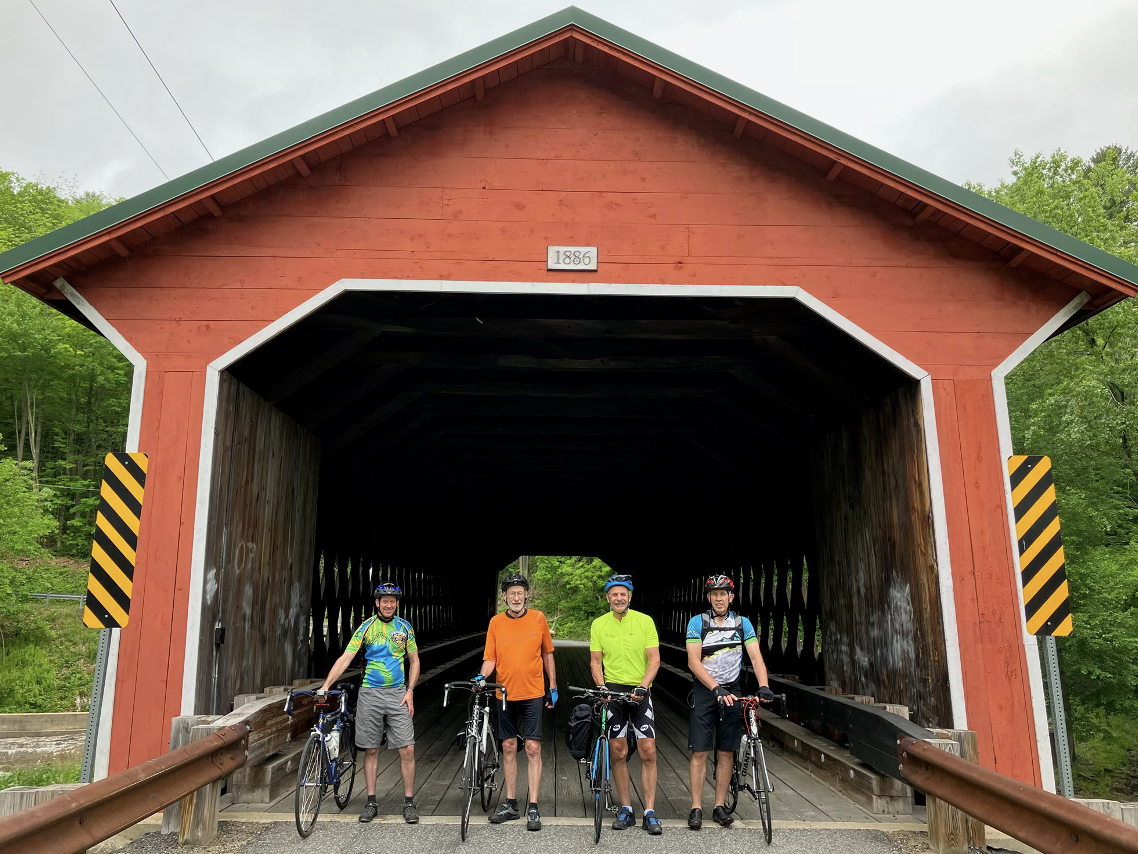
Through our bike trips, we crossed many bridges with Ken. Whether we’re standing under a quaint covered bridge in New England, leaving Portland on a four-lane highway, or girding up for the intimidating American span of the 1000 Island Bridge, these bridges have become not only part of the ride lore, but they also symbolize much of what makes these rides important.
Sometimes what’s special is simply the sense of adventure. As we travel, we often discover hidden gems, such as covered bridges, symbolic of our shared passion for exploration and lifelong learning. Each bridge presents unique photo opportunities and stories about the towns we visit. Just ask Bob how much he learned about Joshua Chamberlain in Maine.
Speaking of Maine, our trip down Route 1 from Rockland, ME to Boston turned into the ‘ride of bridges’ because of the surprisingly many bridges we crossed. They weren’t particularly long or difficult, but they involved way more traffic than we expected. Leaving Portland, we took Route 1 (also Route 295), where we were allowed to bike across to South Portland. Being allowed to is certainly much different from whether we should have. Still, on that four-lane highway, we found that Maine drivers are much more accommodating to bikers than the impatient honkers we encountered almost immediately back in Massachusetts.
In Vermont, the absence of a bridge showed us how clever Vermonters are. Riding along the shores of Lake Champlain, there's an abandoned railway trail that allows bikers to reach South Hero Island. However, there's a 200-foot gap in the trail to let boaters access the northeast section of the lake. Instead of building a bridge, they operated a ferry to carry people and bikes across the gap. We’re still not sure if this is the most cost-effective way to cross, but it definitely made for a fun story. We just had to make sure we didn’t miss the last ferry back to Burlington.
On another trip, we crossed the Cape Cod Canal bridge, which lacks barriers between vehicles and bikers, highlighting that some bridges are more challenging than others. One of the most intimidating bridges, however, is the American span across the St. Lawrence River near Alexandria Bay, NY. Built in 1938, it’s 150 feet high and over a kilometer long. Bikers have to walk their bikes across. Even with a steel partition separating walkers from the traffic, the walk is daunting when 18-wheelers blast by. Needless to say, blood pressures spiked more crossing the bridge than during the 40 miles we had already traveled. Once again, Ken showed what true determination means.
The next day, we piloted my family’s boat under the bridge to Alex Bay. That stretch of the river is narrow and often quite rough for casual boaters. The river is also an important shipping lane for ocean ships heading to the Great Lakes and marks the US-Canada border. Surprisingly, the river was incredibly calm, which symbolized how Ken Wall navigated international relations throughout his career.
As we prepare to bike toward the southern border in Key West and cross the many bridges we will encounter, we carry his sense of adventure, teamwork, quiet resolve, and remarkable ability to embody the values essential for building bridges through international relations. We also need to make sure we are on the correct 7-Mile Bridge into Key West, since the Historic 7-Mile Bridge ends well before we get to Key West. I don’t believe the Burlington gap ferry operates there during its off-season.
Update #2 - March 20, 2026
By: Kevin McAllister
These bike trips of ours require significant planning, even for a short, 3-day trip. We have to decide on a start and an end point, then determine how many miles we need to bike each day. After we decide when to ride, we then have to determine who is making reservations for each night, how we are getting to the starting point, and a host of other decisions that come up when multiple people are trying to create the ‘perfect trip’. Somehow, we are still good friends after all these trips.
One decision we made early on was that we were not going to sleep under the stars or in a Little League dugout like Ken and Sonja’s honeymoon trip. We chose B&Bs or hotels for our sleeping arrangements, preferably with breakfast included. Simple things like a real bed were important.
In fact, after a couple of rides, my wife was telling some co-workers how we carried everything on our bikes; no shag wagon involved. One of her co-workers said, “That’s great! They’re roughing it with tents and sleeping bags.” To which she responded, “Seriously? These guys aren’t roughing it - they're staying in pretty nice B&Bs and hotels!”
Even though we don’t rough it, we still carry limited gear, especially clothing like shirts and shorts. While each of us has our own peccadillos about how we pack light, we all wear shirts and shorts for multiple days. To conserve on socks, someone decided to put their socks in the microwave one morning, hoping to dry them out quickly. FYI, it doesn’t work, and I don’t think we are allowed back in the Middlebury Inn to this day.
We obviously have limited gear with us despite the potential weather, so sometimes you have to ask an innkeeper for an umbrella to stay dry on your walk to dinner. All he had was a 6-foot picnic table umbrella, so, regardless of how goofy we looked walking into the bar that evening, we made do. We were probably the talk of that sleepy little Vermont town that night, and since we had already discovered that microwaves can’t dry clothing, we didn’t mind being the town’s entertainment for a day.
Regardless of the amount of planning, food options can get a little tricky, especially in small, rural locales. One time, our dinner options were limited to the one gas station/pizza shop/deli/package store/justice of the peace/bait shop. At least the pizza wasn’t too bad.
Or the time in Warren, VT, when the innkeeper was willing to drive us to dinner only to have his car break down. Instead, he gave us the keys to a 30+-year-old Ford Ranger pickup truck with an out-of-date New Hampshire plate, no AC on the hottest day of the year, and a stick shift on the floor. I almost knocked Ken’s hip out of joint putting it into reverse with three of us scrunched together in the cab. But it got us there and back, even though I had to plan stops a few hundred yards ahead of time.
No amount of planning prepares you when you’ve never been to a small town in New England before, so we’ve gotten pretty good at making do with wherever and whatever is available. So, when the innkeeper asks you whether you want a big-ass goofy umbrella or whether you can drive stick on a vehicle with questionable brakes, your answer is yes. Also, what happens on tour, stays on tour - so don’t ask who put their socks in the microwave.
Update #1 - March 13, 2026
By: Kevin McAllister
Many of our colleagues and former students ask us how we started our bike trips. If anyone knows us well enough, they will not be surprised that the conversation involved wine and a lot of joking around. Ken, Bob, Dave Andrews, and our spouses were enjoying a dinner together at my house. Ken regaled us with the story of his and Sonja’s honeymoon bike trip from Minnesota to Springfield College to start his graduate work. He still had the Raleigh Grand Prix bicycle in the basement (with the original hard-as-a-rock leather seat) that he had ridden 40 years earlier.
We laughed when we heard about sleeping under the stars or in a Little League dugout. We commiserated as we learned how he walked the bike up the hills of Route 20 near Cazenovia, New York (where my mother is from). Eventually, Dave and Bob suggested that we take trips of our own. The more wine we consumed, the more the idea grew. Bob, Ken, and I immediately agreed to start planning a trip. When asked, Dave quickly said "Hell no, but I will drive the shag wagon for you guys!” And so it began.
Our first trip was a quick 3-day journey from Deerfield, MA, to Wilmington, VT, to Adams, MA, and then back to Northampton. Bob managed to get Ken’s old bike tuned up for ‘one last ride’ (the bike tuner couldn’t guarantee it would last even for that one trip). Sonja drove us to Deerfield to start our ride. A picture of the three of us on the bikes adorned our office space until we moved across campus. We spent the next three days navigating the hills of Rt. 2 and 112, then Rt. 9 in Vermont, and finally Rt 116 outside of Adams. Apparently, Ken’s honeymoon hill rides were an omen to our eventual bike trips. Fortunately, most of the later stages of the ride were downhill on Rt. 9 in Massachusetts into Northampton, where my family met us with a cherry pie for my birthday.
Dave was probably the smart one. He never joined us on the bikes, but still enjoyed beating us in racquetball (there’s more to racquetball than racquetball). Ben joined us a few years later, which actually created a small problem. Ken retired his 40-year old Raleigh for display purposes only, but then borrowed Ben’s Bianchi for a couple of years. We all upgraded our bikes after that, and Ken eventually settled on a Giant Defy.
As we get ready for what would have been Ken’s 15th bike trip, we can’t help but reflect on how it all began. Three Springfield College department colleagues having a taste of the grape with a good friend who suggested we should start biking—how else do you come up with a crazy idea to find the next hill Ken could walk up? Biking was just the by-product of a friendship that grew from the great and humorous stories that came out of these trips. There is more to biking than simply biking. It was (and always will be) about camaraderie, collaboration, laughter, motivation, and Ken’s relentless grit to finish a day’s ride despite the times I lied about the mileage. We will keep riding to honor Ken’s international and personal legacy – he will always be with us.